Top 10 CAD Design Skills Every Designer Must Learn in 2026
Quick Summary:
1. Industry-Standard Software Mastery Is Essential – Proficiency in tools like AutoCAD, SolidWorks, and Revit is the foundation for any CAD designer’s career.
2. Strong Basics Still Drive Success – 2D drafting, dimensioning, and engineering drawing knowledge remain critical despite advanced technologies.
3. 3D Modelling & BIM Are Core Requirements – Parametric design and BIM workflows are now standard across engineering and construction industries.
4. AI & Simulation Are Game-Changers – Generative design and FEA tools help designers create smarter, optimized, and test-ready models faster.
5. Collaboration & Communication Skills Matter More – Cloud-based workflows and teamwork skills are essential for working in modern, distributed design environments.
If you are serious about building a strong career in design, knowing the right CAD design skills in 2026 is non-negotiable and the answer goes well beyond just learning a software. From nailing the basic CAD skills like 2D drafting and parametric 3D modelling, to working confidently with AI-assisted design tools, BIM workflows, FEA simulation, cloud collaboration, and GD&T these are the skills that India’s top employers are actively hiring for right now. Whether you are a fresher stepping into the field or an experienced professional looking to stay relevant, this guide breaks down exactly what to learn, why each skill matters, and how it fits into the real world of design in 2026.
Why CAD Design Skills Matter More Than Ever in 2026
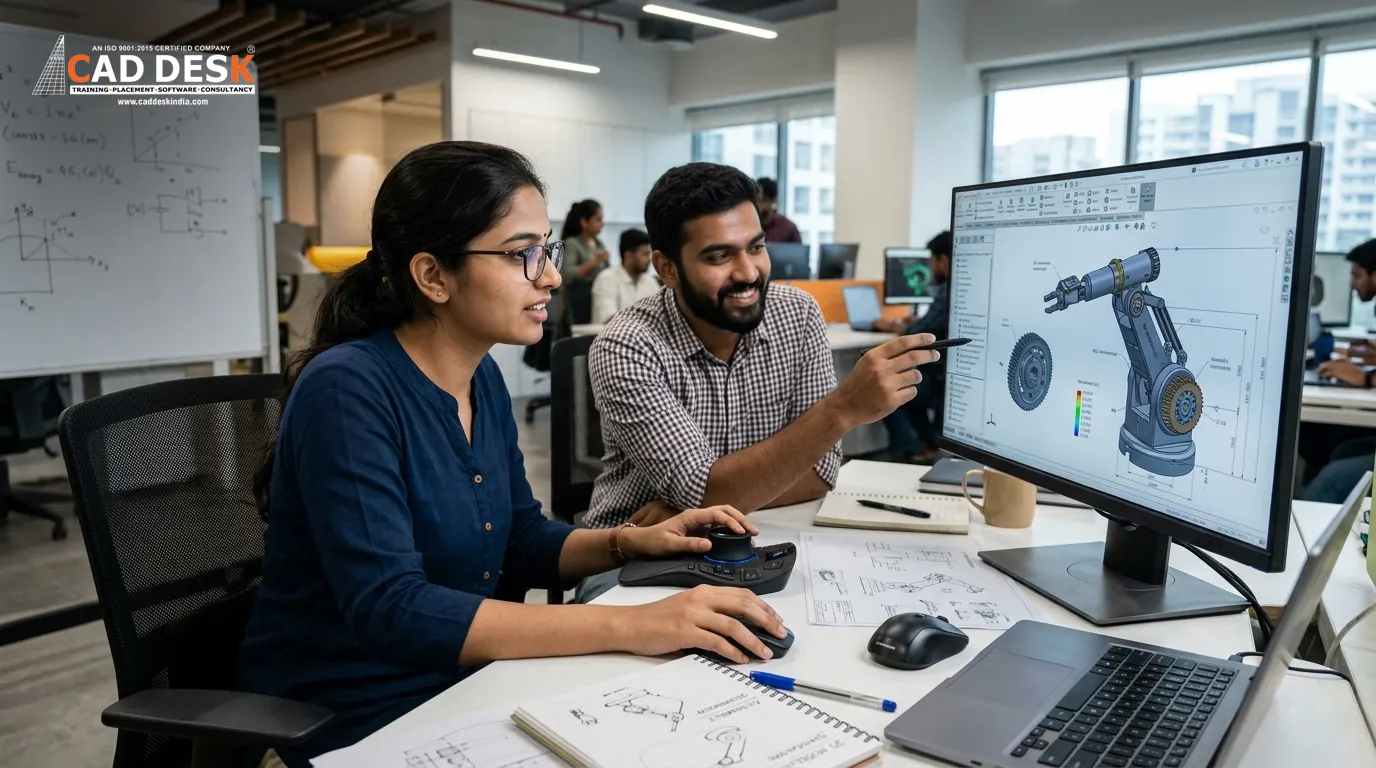
The world of CAD design is no longer just about drawing lines on a screen. In 2026, CAD professionals are expected to work with intelligent tools, cross-functional teams, and cloud-based platforms all at the same time. In India especially, the demand for skilled CAD designers is growing rapidly across sectors like manufacturing, construction, automotive, aerospace, and product design.
If you are planning a career in this field or looking to level up your current skills, understanding which CAD design skills are actually valued by employers right now is the smartest place to start. Let us dive in.
1. Proficiency in Industry-Standard CAD Software
This is the foundation and it still tops the list in 2026. You must have hands-on expertise in at least one or two major CAD tools. The most widely used platforms today include:
- AutoCAD – still the most popular choice across architecture and civil engineering projects
- SolidWorks – a favourite in mechanical and product design
- CATIA – heavily used in aerospace and automotive sectors
- Fusion 360 – popular among startups and product designers for its cloud-first approach
- Revit – the go-to for BIM-based architecture and construction work
Employers do not just want someone who “knows” these tools. They want designers who can work fast, handle complex assemblies, and troubleshoot on the go. Being certified in any of these platforms gives you a real edge in the job market.
2. Understanding of Basic CAD Skills and 2D Drafting
Even in a world moving towards 3D modelling and automation, solid basic CAD skills remain non-negotiable. 2D drafting is still widely used in civil, structural, and electrical engineering disciplines. Many project documentation workflows still rely on clean, accurate 2D drawings.
Understanding layers, line types, dimensioning standards, annotation tools, and drawing templates is something every CAD designer must be confident about. If your basics are weak, your 3D work will also suffer. Think of basic CAD skills as the grammar of the language you cannot write well without it.
3. 3D Modelling and Parametric Design
3D modelling has become a core requirement across almost every industry. In 2026, parametric design where changing one dimension automatically updates the entire model is the standard way of working.
You should be comfortable creating solid models, surface models, and assemblies. Understanding constraints, sketches, features, and design intent will help you build models that are not just visually accurate but also functional and easy to modify later.
This skill is especially important if you are targeting careers in product design, mechanical engineering, or industrial design roles.
4. BIM (Building Information Modelling) Knowledge
For those working in architecture, civil engineering, or construction, BIM is no longer optional. Building Information Modelling goes beyond 3D design; it incorporates scheduling, cost estimation, facility management data, and more.
In India, the government’s push for smart cities and infrastructure projects has made BIM a high-priority skill. Knowing tools like Revit, Navisworks, or ArchiCAD, along with understanding IFC standards and model coordination workflows, makes you much more valuable in the AEC (Architecture, Engineering, and Construction) sector.
5. AI-Assisted Design and Generative Design Tools
This is one of the biggest shifts happening in 2026. AI is now being embedded directly into CAD platforms. Autodesk’s generative design features, for example, allow the software to generate multiple design options based on your inputs like material, load conditions, and manufacturing constraints.
As a CAD designer, you do not need to become an AI engineer. But you do need to understand how to work with AI-generated outputs, evaluate them critically, and use them as a starting point rather than a final answer. Designers who are comfortable using AI tools are significantly more productive and more sought-after right now.
6. Simulation and FEA (Finite Element Analysis)
Designing a product and testing it virtually before manufacturing is now a standard part of the workflow in many industries. FEA and simulation tools allow you to check how a component will behave under stress, heat, pressure, or vibration.
Software like ANSYS, SolidWorks Simulation, and Nastran are commonly used for this. Even a basic understanding of how to run a structural or thermal simulation can set you apart from other CAD professionals. Companies in India’s manufacturing and automotive sectors actively look for designers who can handle this.
7. Cloud Collaboration and Remote Design Workflows
Post-2020, remote work and cloud-based collaboration became permanent features of the design industry and in 2026, they are completely mainstream. Tools like Autodesk Fusion 360, Onshape, and BIM 360 allow teams to work on the same design simultaneously from different locations.
As a CAD designer, you must be comfortable with version control, cloud-based file management, and real-time collaboration features. The ability to work effectively in a distributed team is now just as important as your technical design skills.
8. GD&T (Geometric Dimensioning and Tolerancing)
GD&T is a system for communicating engineering tolerances and specifications. It is the universal language used between designers and manufacturers to ensure parts are made correctly.
In India’s growing manufacturing sector particularly in precision engineering, automotive parts, and exports GD&T knowledge is highly valued. If you can read and apply GD&T symbols correctly, you will be able to create drawings that are clear, precise, and ready for production without back-and-forth confusion.
9. Rendering and Visualisation Skills
The line between CAD designers and product visualisers is getting thinner. In 2026, clients, stakeholders, and marketing teams expect photorealistic renders and even interactive 3D walkthroughs before a product goes into production.
Learning tools like KeyShot, V-Ray, or the built-in rendering features of SolidWorks and Fusion 360 gives you the ability to present your designs in a compelling, client-friendly way. This is especially useful if you are working in product design, interior design, or architecture.
For designers looking to explore how strong CAD design skills open up diverse career paths, do check out this detailed guide on top CAD designer jobs and career opportunities in 2026 it breaks down the roles, salary expectations, and industries hiring actively right now.
10. Communication and Cross-Functional Collaboration
This one surprises a lot of people, but in 2026, soft skills around communication have become a core CAD competency. CAD designers regularly work with engineers, project managers, procurement teams, and clients. Your ability to explain design decisions, take feedback constructively, and update drawings based on changing requirements is just as important as your software skills.
Knowing how to present a design review, document changes clearly, and communicate through collaborative platforms like Microsoft Teams or Slack is now part of the everyday toolkit for most CAD professionals.
Conclusion
The CAD design field in 2026 is exciting, competitive, and full of opportunities especially in India, where infrastructure, manufacturing, and product design sectors are growing at a rapid pace. But to stay relevant and in demand, you need to go beyond just knowing how to use software. You need a well-rounded skill set that includes technical depth, knowledge of modern workflows, and the ability to work in collaborative, fast-moving environments.
Whether you are a student just entering the field or a working professional looking to upskill, investing in the right CAD design skills today will pay off in a big way tomorrow. Focus on both your basic CAD skills and the newer, in-demand areas like AI-assisted design, simulation, and BIM because that combination is what employers are actively looking for.
If you want to know more about how to build the right skills or are looking for professional CAD design support for your project, feel free to reach out to us here. Our team would be happy to help guide you in the right direction.
Frequently Asked Questions
The most important CAD design skills in 2026 include proficiency in industry-standard software like AutoCAD, SolidWorks, and Revit, along with strong 2D drafting and 3D modelling abilities. Designers must also understand BIM workflows, simulation tools like FEA, and AI-assisted design features. In addition, skills like GD&T, rendering, and cloud collaboration are highly valued. Employers are increasingly looking for professionals who combine technical expertise with communication and problem-solving abilities to handle real-world design challenges effectively.
Yes, 2D drafting remains highly relevant in 2026 despite the rise of 3D modelling and automation tools. Many industries such as civil, structural, and electrical engineering still rely on detailed 2D drawings for documentation and approvals. Strong fundamentals in layers, dimensioning, annotations, and drawing standards are essential for creating accurate designs. Without a solid understanding of 2D drafting, it becomes difficult to produce precise 3D models or communicate design intent clearly to engineers and stakeholders in real-world projects.
BIM, or Building Information Modelling, is crucial because it integrates design, construction, and project management into a single workflow. In 2026, BIM is widely used in architecture, engineering, and construction industries to improve efficiency and reduce errors. It allows designers to work with data-rich models that include cost estimation, scheduling, and facility management information. With increasing infrastructure projects, especially in India, BIM skills significantly enhance job opportunities and make CAD designers more valuable to employers across large-scale projects.
AI is transforming CAD design by introducing generative design and automation features that help designers create optimized solutions quickly. Instead of manually testing multiple design options, AI tools can generate several alternatives based on constraints like materials and load conditions. However, designers must still evaluate and refine these outputs. In 2026, CAD professionals who understand how to use AI effectively gain a competitive advantage, as they can work faster, improve accuracy, and deliver more innovative solutions in less time.
Parametric 3D modelling is a design approach where changes to one part of a model automatically update related components. This makes the design process more flexible and efficient. In 2026, it is a core skill for CAD designers working in product design, mechanical engineering, and industrial design. It allows designers to easily modify dimensions, test variations, and maintain consistency across complex assemblies. This capability is essential for reducing errors, improving productivity, and adapting designs quickly to changing project requirements.
Yes, learning simulation and FEA (Finite Element Analysis) tools is highly beneficial for CAD designers in 2026. These tools allow designers to test how a product performs under real-world conditions such as stress, heat, or pressure before manufacturing. Software like ANSYS and SolidWorks Simulation is widely used in industries like automotive and manufacturing. Even a basic understanding of simulation helps designers create more reliable and efficient products, making them more valuable to employers and improving overall design quality.
GD&T (Geometric Dimensioning and Tolerancing) is a standardized system used to define engineering tolerances and ensure manufacturing accuracy. It helps communicate design intent clearly between designers and manufacturers. In 2026, GD&T is especially important in precision industries like automotive, aerospace, and manufacturing. By using GD&T symbols correctly, CAD designers can reduce production errors, avoid miscommunication, and ensure that parts fit and function as intended, making it a critical skill for professional design workflows.
Yes, rendering and visualization skills are increasingly important for CAD designers in 2026. Clients and stakeholders expect photorealistic images and interactive presentations before approving a design. Tools like V-Ray, KeyShot, and built-in rendering engines help designers create high-quality visuals. These skills are especially valuable in architecture, interior design, and product development. Strong visualization abilities not only improve client communication but also enhance the overall presentation and marketability of a design project.
Communication skills are essential for CAD designers because they work closely with engineers, project managers, and clients. In 2026, design projects are highly collaborative and often involve remote teams. Designers must clearly explain their ideas, understand feedback, and update designs accordingly. Good communication ensures fewer errors, smoother workflows, and better project outcomes. It also helps in presenting designs effectively during reviews and meetings, making it a key factor in career growth and professional success.
Beginners can start by learning the basics of 2D drafting and gradually move to 3D modelling using tools like AutoCAD or SolidWorks. Building a strong foundation in engineering drawing concepts is essential. After that, they can explore advanced areas like BIM, simulation, and rendering. Practicing real-world projects, creating a portfolio, and earning certifications can significantly improve job prospects. In 2026, combining technical skills with knowledge of modern tools like AI and cloud collaboration will help beginners stand out in the competitive CAD job market.